Breaking Ad Dependency for a D2C Brand (Scaling to 100+ Daily Orders Directly via AI Search)
- May 8
- 4 min read
1. Starting Day
We launched our custom algorithmic optimization framework with this brand in September 2025.
2. Reason Client Started This Project
As an e-commerce Direct-to-Consumer (D2C) brand, the client was trapped in a dangerous cycle of rising ad dependency. Their profit margins were consistently being crushed by skyrocketing Customer Acquisition Costs (CAC) across Meta, TikTok, and Google Ads. Every time they scaled down their ad spend, their revenue plummeted. Furthermore, their leadership team recognized a major shift in consumer behavior: modern shoppers were no longer just searching for product keywords. Instead, buyers were using conversational platforms like ChatGPT, Gemini, and Perplexity to ask complex transactional questions like, "What are the most durable, eco-friendly travel backpacks under €150 that fit European budget airline carry-on rules?" The client realized that traditional SEO and standard paid ads couldn't capture these long-tail, hyper-specific query structures. They needed a system to establish their brand as the definitive product recommendation inside the AI Answer Box.
3. Expectations
Transition the brand away from absolute ad dependency by building a highly profitable, organic revenue channel.
Secure consistent product recommendations and active citations across major AI search engines.
Increase e-commerce conversion rates by attracting highly informed, high-intent buyers who are already pre-nurtured by AI.
4. Actions Taken (The Ultimate AEO System Build)
To optimize a high-inventory D2C e-commerce platform for Large Language Models, we deployed the Ultimate AEO System with an emphasis on catalog indexing and multi-source social proof:
Phase 1: Product Knowledge Ingestion & Semantic Optimization
Comprehensive Data Ingestion: We mapped the brand's entire product catalog, extracting technical specifications, materials data, unique selling propositions (USPs), and logistics details into an optimized, AI-readable corporate knowledge base.
The High-Intent E-Commerce Glossary Launch: We built a dedicated technical Glossary mapping their first 100 transactional user queries. We moved past generic definitions to map deep-intent buyer jargon, contextual product use cases, and comparative material terms, creating a vital semantic anchor for conversational engines.
Advanced Technical E-Commerce Schema Setup: We deployed comprehensive product JSON-LD data schemas across all categories and implemented a strict, technical llms.txt file implementation. This served as a structured data directory, giving automated crawlers like GPTBot and ClaudeBot clear, authoritative access to real-time inventory assets, product parameters, and compliance details.
Infrastructural Entity Alignment: We crafted a 10-piece deeply researched FAQ Hub addressing product sizing, wear-and-tear expectations, and shipping protocols. We fully optimized their external digital footprints, local directories, and brand graphs to ensure absolute entity consensus across the web.
Phase 2: Ongoing Catalog Ingestion & Community Consensus Engineering
Real-Time Consumer Query Tracking: We actively tracked up to 100 conversational keywords, consumer intent shifts, and product comparison queries that users were inputting into generative engines.
Dynamic Content Expansion & Glossary Management: Every month, we pushed 4 deeply researched AEO Content Pages onto their CMS and added 3 category/product-level FAQs. Concurrently, our monthly Glossary Management continuously updated product definitions and materials science terms to align with seasonal shopping trends.
The Social Proof Consensus Engine: AI models confidently recommend products only when they can find third-party validation across the web. To build this trust loop, we seeded 3 high-authority community mentions per month across platforms like Reddit, X, and specialized lifestyle forums from a natural, third-person perspective. We positioned the client's products organically inside active buyer recommendation threads, creating the explicit "digital footprint of trust" that ChatGPT and Claude require to recommend a specific e-commerce brand.
30-Day Visibility Optimization: We audited their "Share of Model" percentage monthly, evaluating live conversational outputs to continuously capture a larger volume of organic product recommendations.
5. Time of Case Study
This case study reflects an 8-month performance timeframe, tracking progress from the initial deployment in September 2025 through early May 2026.
6. Results
Shifting from a pure ad-dependent acquisition strategy to a reasoning-based AEO framework yielded extraordinary, margin-saving results for the D2C brand:
100+ Daily Orders Directly via AI Search: The brand scaled from zero AI presence to consistently generating over 100 orders per day originating directly from user recommendations on ChatGPT, Perplexity, and Gemini.
Drastic Reduction in CAC: By capturing a massive volume of high-converting, organic AI traffic, the brand significantly lowered its overall Customer Acquisition Costs, immediately restoring healthy profit margins.
The Business's Best Performing Channel: The inbound AEO infrastructure matured into the client's highest-converting, most stable marketing channel, outperforming classic social media advertising.
7. Feedback from Client
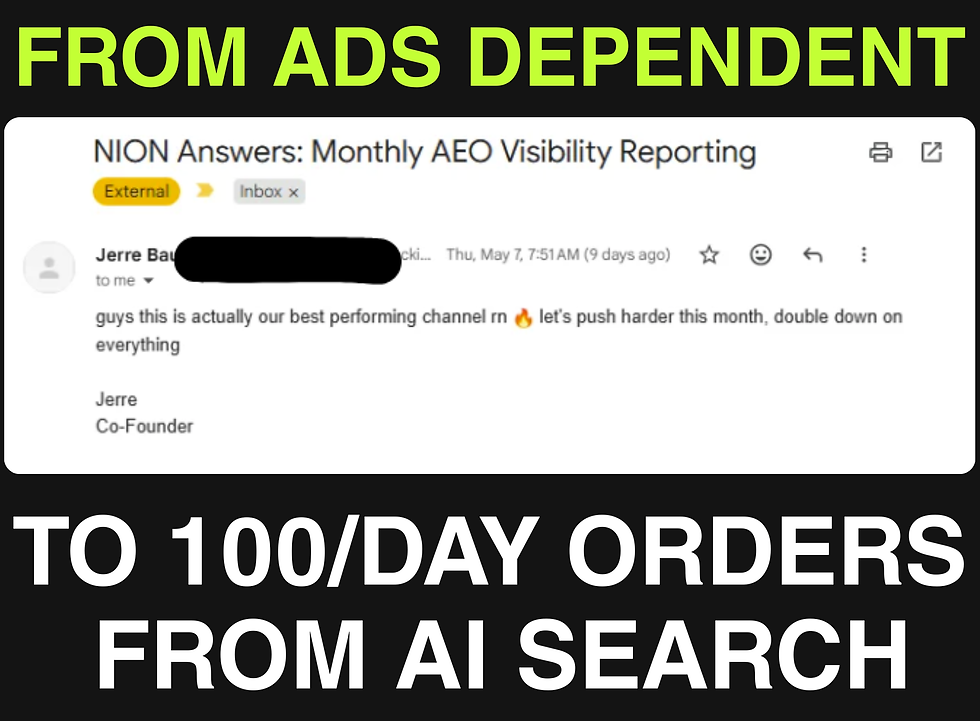
Upon receiving their monthly analytical breakdown in May, the co-founder (Jerre) sent an immediate response to our operations team, highlighting the system's role as their primary growth engine:
"guys this is actually our best performing channel rn 🔥 let’s push harder this month, double down on everything. Jerre, Co-Founder"
8. How We Measure / KPIs
Inbound Conversational Order Volume: We track direct attribution and checkout conversions originating from users landing on the site via generative search engine recommendations.
Ad Budget Efficiency Index (ROAS vs. AEO): We monitor the brand’s overall return on marketing spend by contrasting volatile paid acquisition metrics against the compounding returns of the AEO infrastructure.
Share of Model Product Penetration: We measure the frequency with which the client's products appear as top-three choices when shoppers ask LLMs for category-specific purchasing recommendations.
9. Why Work With Nion-Answers?
Flipping the script on e-commerce means refusing to let renting ad space dictate your brand’s survival. At Nion-Answers, we build permanent digital authority. Our greatest partnership strengths include:
We Work Closely with Each Client: We treat your store like our own. We form a tight, dedicated partnership with your internal team to thoroughly translate your product catalog advantages into data assets that AI engines inherently trust.
Personalized Strategy over Cookie-Cutter Packages: We don't believe in generic content. We dissect the exact product comparison prompts your specific target audience is giving to AI engines, cutting out the fluff to focus strictly on what drives purchase orders.
A Disciplined Loop of Strategy, Execution, and Insights: Our system relies on absolute operational consistency. We map out data-driven strategies, execute technical tasks flawlessly (including advanced Schemas, llms.txt, and active glosaries), deliver transparent monthly visibility reports, and immediately apply those learnings to optimize your catalog for the next timeframe.
Unmatched Mastery of the AI Revolution: The generative engine ecosystem updates constantly. By keeping your e-commerce data infrastructure perfectly tuned to the latest updates from OpenAI, Anthropic, and Google, we ensure your products stay positioned as the default choice for ready-to-buy consumers.
Want to turn AI search into your brand's unfair advantage? Let’s talk.


Comments